


Duplicate Removal: Why Every Lead Counts Once
By Ray Advertising · Published April 23, 2026

You pay for leads. You expect each one to be a real chance to make a sale. But what if the same person shows up twice in your system? Or three times?
Imagine you pay for 1,000 leads this month, then discover 150 are repeats. You did not buy 1,000 opportunities. You bought 850 and paid extra for the rest.
This is not just a messy database issue. It is a profit issue.
Duplicate waste eats into your budget and burns out your sales team. Even worse, they frustrate your customers and hurt trust. It is easy to miss because the lead count looks strong on paper, even while real sales stay flat.
That is why duplicate removal matters. When every lead counts once, your data becomes clear, your team works faster, and your budget works harder. In this guide, you will learn how to find repeats and build a system where every lead counts once.
What “Every Lead Counts Once” Actually Means
When we say every lead counts once, we mean something simple. Your data should be a clear map, not a messy pile of names.
To make this work, one lead must mean four things:
✔ One person: You are talking to a real human, not a list of emails.
✔ One record: There should be only one file for that person in your system.
✔ One sales journey: Your team follows one clear plan to talk to them.
✔ One source of truth: You know exactly where that lead came from.
If you have two or three files for the same person, your math breaks. You may think you have more interest than you really do. Your reports start to look better than reality.
When you fix this, you see the truth. You know which ads bring real buyers. You know how much money you are actually making. Most of all, you can trust your numbers.
The Hidden Cost of Duplicate Leads
Duplicate leads cost you more than you think. It is like having a leak in your water pipe. You are paying for something that just disappears.
Here are the four ways you lose money:
- Wasted Ad Money: You pay to find a new person. If your system saves them twice, you might pay to find them again. That is money you could use to find a real new customer.
- Wasted Sales Time: Your sales team stays busy. If they spend all day calling the same leads, they cannot talk to new buyers.
- Wrong Numbers: If your data is messy, your reports will be wrong. You might think an ad is working great when it is really just finding the same people twice.
- Bad Reputation: People do not like getting many calls from the same company. It can make your brand look unorganized. They may get annoyed and choose another company.
Let’s look at the math
Think about your sales team. If they spend 20% of their time talking to duplicate leads, you lose 20% of their productivity. That is like losing one whole day of work every single week.
This is not just a small computer problem. It is a growth problem. Every minute spent on a repeat lead is a minute spent not making a sale.
Why More Leads Can Mean Less Revenue
Most people think more leads are always a good thing. They try to get as many names as possible. But if those names are just repeats, you are moving backward.
Here is why too many low-quality leads can hurt you:
- Fake Growth: Big numbers can hide the fact that you are not getting real new customers.
- Bad Reports: Repeats mess up your math and make it hard to see the truth.
- Wrong Choices: You waste money on ads that find people you already have.
In business, quality is always better than quantity. It is better to have ten real leads than fifty repeats.
When you focus only on big numbers, you lose sight of real sales. You end up busy, but you don't end up with more money.
Where Duplicate Leads Really Come From
It‘s not always a mistake when you get the same lead twice. Usually, this happens because of how people behave online or how different systems share and save data.
✔ Multi-submit behavior on slow forms
If a website is slow, people get impatient. They click the "submit" button multiple times because they think it’s not working. This sends their info to you three or four times.
✔ Multi-device browsing
Someone might look at your site on their phone while on the bus. Later, they go home and sign up on their laptop. Your system thinks this is two different people.
✔ Price comparison shoppers
People love to compare prices. They may submit their information on several forms while checking prices.
✔ Shared lead distribution networks
Some companies sell the same lead to everyone. If you buy from two different places, you might end up paying for the same names twice.
✔ Old CRM imports
When you move data from an old system to a new one, it often gets messy. If you aren't careful, old names get mixed in with your new ones.
✔ Automation sync errors
Marketing tools and CRMs sometimes fail to sync properly. A small glitch can allow the same lead to pass your system more than once.
When you know where these repeats come from, it is much easier to stop them.
The Customer Experience Damage Most Companies Ignore
Most companies don't realize how much these repeats hurt their reputation. When your data is a mess, the customer feels it.
Think about how it looks from their side. If two different salespeople call the same person on the same day, it feels sloppy. It makes your business look like it doesn't know what it's doing. To the customer, those extra calls don't feel like "follow-ups," they feel pushy and annoying.
When this happens, you lose trust fast. People get frustrated and ask to be taken off your list. Some may walk away and never return to buy from you again. It's a quiet way to lose a lot of money.
Good business is simple. One person should have one clean conversation with your team. This shows you respect their time, and it makes them much more likely to trust you.
How to Remove Duplicates Without Breaking Your Data
Removing duplicates is important. But you must do it carefully. If you delete data without planning, you can lose useful information.
Here are five simple steps to fix your data without losing any important info—
Step 1: Back up your database
Always save a copy of your list first. If you make a mistake, you can just go back to the start. This keeps your data safe.
Step 2: Match by email and phone
Start with the easy stuff. Look for people with the same email address or the same phone number. These are almost always the same person.
Step 3: Look for similar names
Sometimes names are spelled a bit differently. One person might be "Jon" in one spot and "Jonathan" in another. Look for these small changes so you do not miss any repeats.
Step 4: Merge the files
Do not just delete the repeats. Instead, merge them. This means you take two files and turn them into one perfect record.
Step 5: Preserve activity history
When you merge, make sure you keep the notes from both files. You want to see every time that person talked to your team in the past.
One big warning:
Never just hit "delete." If you delete a repeat without merging it, you lose all the history forthat person. This will break your reports and confuse your sales team.
Real-Time Duplicate Prevention Strategy
Cleaning your data is good, but stopping repeats before they start is even better. It is much easier to keep a room clean than to clean it every day.
Here is how you stop duplicates in real time:
✔ Check emails on your forms to make sure they are real before they get saved.
✔ Make every phone number look the same by using one simple format.
✔ Ignore extra clicks if someone hits the submit button many times in a row.
✔ Look at the device or internet address to see if the same person is signing up again.
✔ Search your current list for a match before you add any new name to your system.
When you stop repeats from getting in, you protect your money. Your team stays busy with new sales instead of fixing old mistakes.
Build a Clean Lead Workflow That Protects Growth
To keep your business growing, you need a simple plan for every new lead. This workflow keeps your data clean from start to finish.
The Clean Lead Workflow
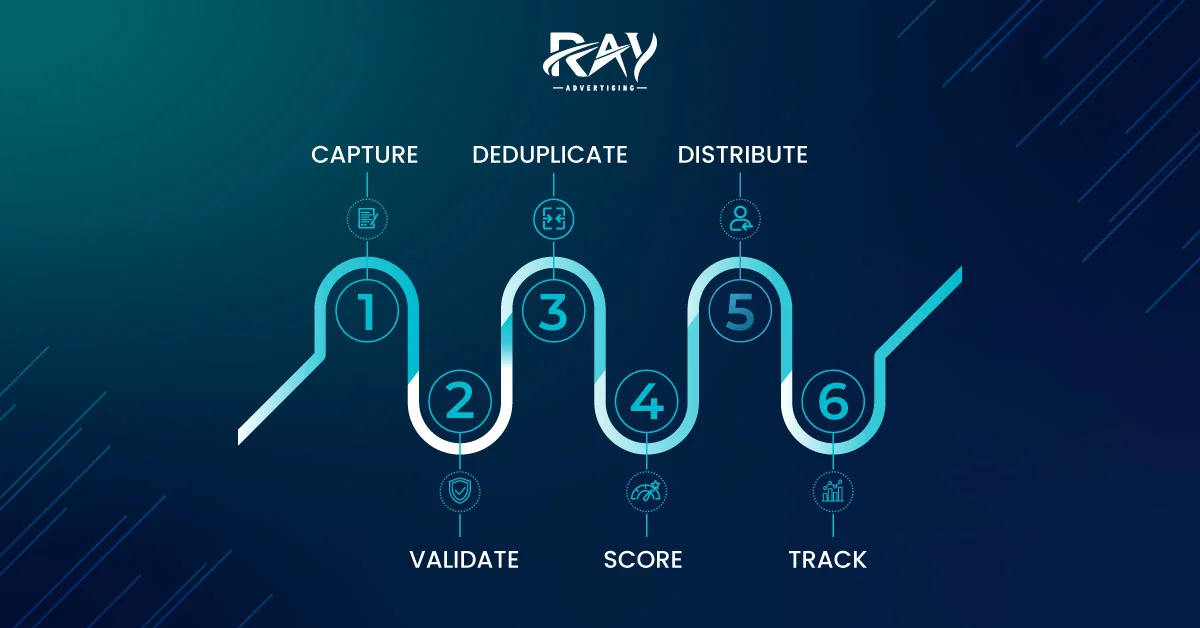
Capture → Collect the info from your website or ads.
Validate → Check to see if the email and phone number are real.
Deduplicate → Look for that person in your system to see if they are already there.
Score → Decide how ready they are to buy based on what they did.
Distribute → Send the lead to the right salesperson immediately.
Track → Watch what happens next to see if the lead turns into a sale.
Keep your data healthy with these simple checks:
- Daily: Find and fix any new repeats that got through your filters.
- Weekly: Pick a small group of leads to make sure the info is correct.
- Monthly: Review reports every month to see if your data remains clean.
Clean systems create steady growth. You stop wasting time and start closing more deals.
How Clean Data Improves Conversion and ROI
Clean data helps your business grow. When your list is clean, your team can call new leads right away. Fast calls usually mean more sales.
It also helps you find the right people. You stop spending money on ads for people who will never buy. This saves you a lot of cash.
Your results also become much clearer. You can finally see which ads are working and which ones are a waste. This helps you make smarter marketing choices.
When your data is clean, you can trust your numbers. That confidence helps you make big moves that bring in more money.
Simple Audit Checklist You Can Use Today
You can use this simple checklist to see if your data is healthy. If you say no to any of these, it might be time to make a few changes.
Do you track unique leads?
Check if each person has just one record. This keeps things organized.
Do you block repeat submissions?
Make sure your forms stop the same person from signing up many times in a row.
Do you merge instead of delete?
Merging is better because it keeps your notes and history safe.
Do you audit weekly?
Frequent checks help you find and fix small problems.
Checking these things today will save you a lot of time and money later.
Final Message: Growth Starts With One Clean Record
Growth starts with keeping your data clean. Every lead on your list is important. Each one represents:
✔ Real money you spent to find them.
✔ The real time your team spends calling them.
✔ A real chance to make a new sale.
If one person shows up twice, your system is not working properly. It wastes your time and money.
Protect every lead you get. Make sure each one counts exactly once. When you respect the data, you respect the customer. This is how you build a business that lasts
Recent Post
How Internal Dashboards Improve Lead Predictabilit...
May 18, 2026
From Network to Direct Supply: How We Control the ...
May 12, 2026
Why API Lead Delivery Outperforms CSV Faster, Clea...
May 4, 2026

Multi-Step QA Explained: How We Stop Bad Leads Bef...
April 25, 2026
Duplicate Removal: Why Every Lead Counts Once...
April 23, 2026
What Is a High-Intent Lead Definition, Signals & S...
April 13, 2026

The Hidden Cost of Non-Compliant Leads (And Why Ch...
April 20, 2026
How We Maintain Lead Intent from First Click to Sa...
April 9, 2026
In-House Lead Generation vs Brokered Traffic...
April 1, 2026
Related resources
Explore the most relevant pages based on this article.
- Contact Ray Advertising — Ask about pricing, compliance, and launch timelines.
- Lead Generation — Lead scoring, duplicate removal, compliance screening, and delivery.
- Advertiser Solutions — Brand-safe performance marketing for measurable ROI.
- Pay Per Call — Qualified inbound calls with validation and tracking.
- Media Buying — Intent-driven traffic with tracking and controls.

FAQs
Quick answers related to this article.
A qualified lead meets your targeting rules (geo, intent, required fields) and passes duplicate and compliance filters.
We run suppression and matching checks in real time and can enforce recency windows and field-level matching rules.
Campaigns use approved creatives, consent-aware flows, and monitoring to flag and pause non-compliant sources.

