


Exclusive Auto Insurance Leads: Are They Worth the Cost?
By Ray Advertising · Published August 7, 2026
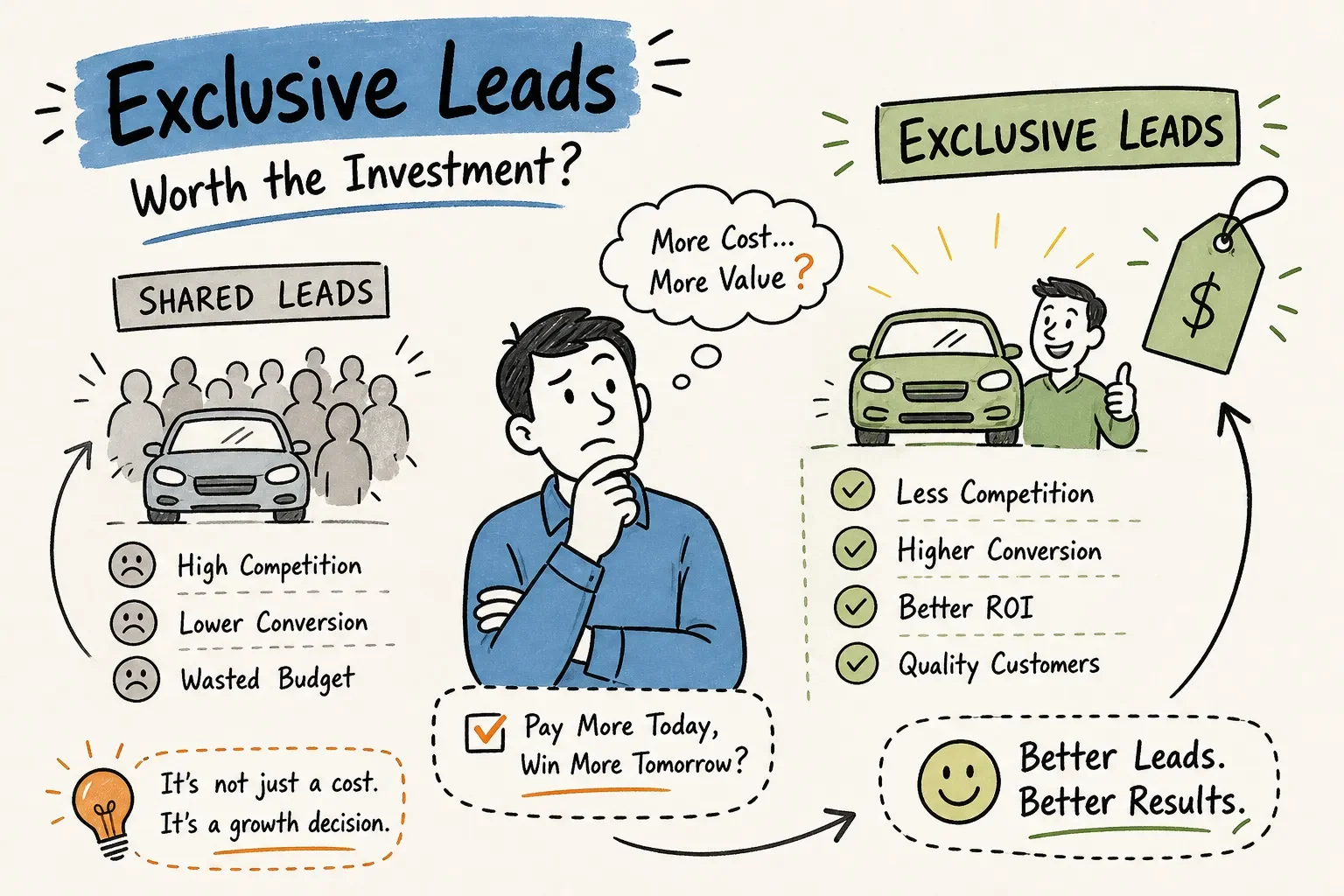
Exclusive Auto Insurance Leads: Are They Worth the Cost?
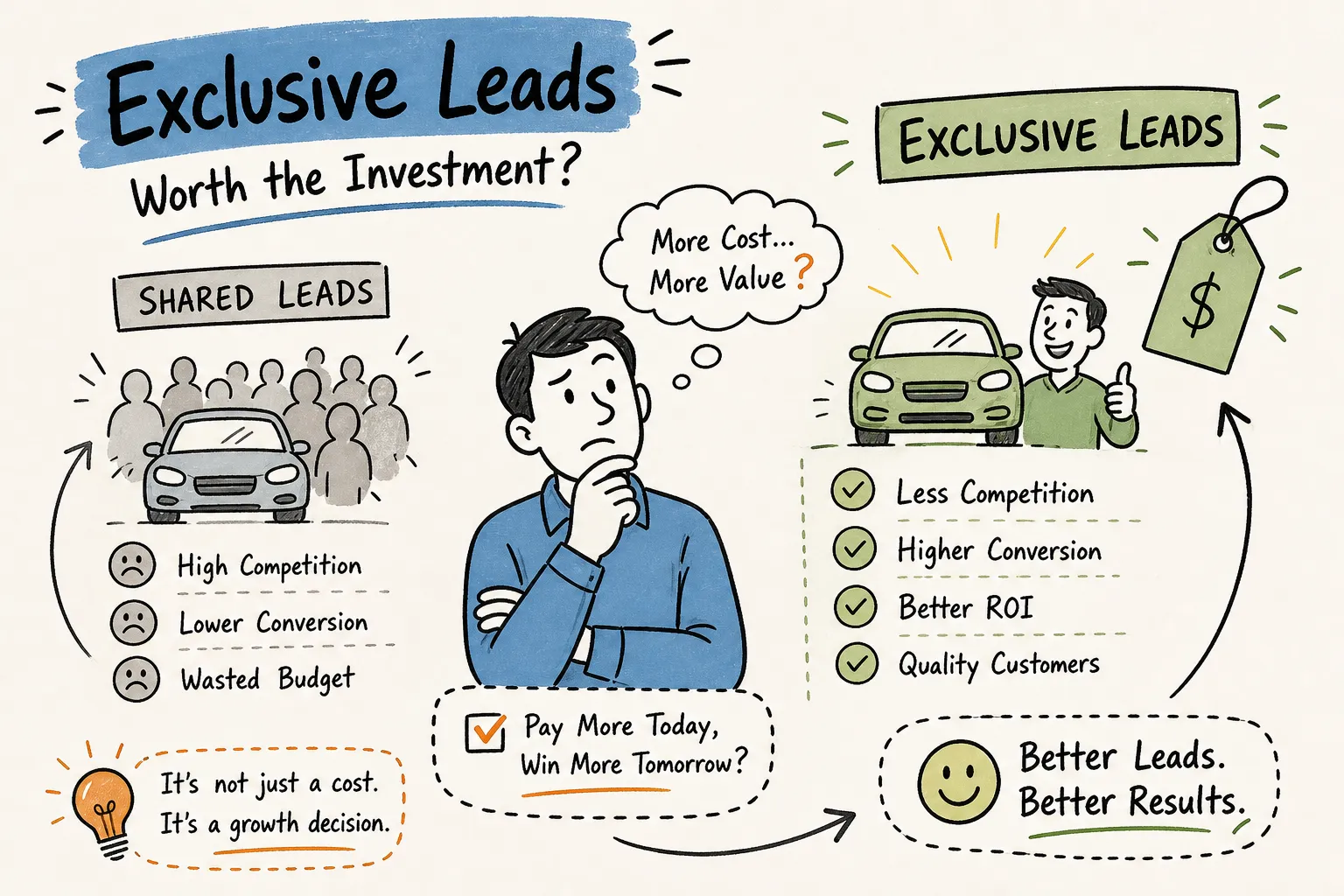
Every agent eventually hits the same wall. The per-lead price on exclusive auto insurance leads looks steep compared to shared inventory, and the instinct is to go cheaper. That instinct is usually wrong, and the math is why.
The real question isn't "what does this lead cost?" It's "what does this policy cost to acquire?" Those are completely different calculations, and most agents only run the first one. This article walks through the full framework: how exclusive and shared leads actually work mechanically, what exclusivity does to your contact and close rates, the CPA arithmetic that settles the debate, how to evaluate lead quality before you buy, how to vet vendors, and how to structure a pilot test without overcommitting budget.
One note upfront: some performance lead providers operate entirely on a 100% exclusive model where every record goes to a single agent and delivery happens in real time, within five minutes of consumer intent. Ray Advertising is built on that structure. That operational choice produces measurably different outcomes than what shared aggregators deliver, and this article breaks down exactly why.
What separates exclusive auto insurance leads from shared inventory
How shared leads are bought and sold
Shared lead aggregators work simply: a consumer fills out a quote form online, and that same record is sold simultaneously to four, six, sometimes ten agents across competing carriers. The agent receiving that lead isn't calling a prospect. They're entering a race against up to nine other callers, all with the same phone number, all in the first 60 to 90 seconds after that form was submitted.
The per-lead price on shared inventory typically runs $3 to $15 per record, which looks attractive on a spreadsheet. What the spreadsheet doesn't show is the conversion penalty you absorb when the prospect picks up the first call, gets two more mid-conversation, and stops answering entirely by the fourth ring. That per-lead discount evaporates fast when your close rate bottoms out.
What a 100% exclusive lead actually looks like
True exclusivity means one lead, one agent, no reselling, no recycling to a second buyer after a waiting period. Delivery timing matters as much as exclusivity itself. A real-time exclusive lead delivered within five minutes of submission behaves completely differently from an "exclusive" lead aged 24 to 48 hours before it ever reaches your inbox. Consumer intent degrades fast, and freshness is what separates a warm prospect from a cold file.
Single-owner auto leads represent the highest-accountability tier of the market. When a vendor's business model depends entirely on one agent's success with each record, their incentive structure aligns with yours. That alignment doesn't exist in a shared model, where the vendor has already sold the same record multiple times before your results even come in.
Why exclusive auto insurance leads raise your contact rate and close rate
The conversion gap between exclusive and shared auto leads
The benchmarks are consistent across the industry. Exclusive auto insurance leads convert at roughly 10 to 25%, while shared leads land between 1 and 10% depending on speed-to-lead and follow-up quality. That gap doesn't sound dramatic until you model it across volume. An agent buying 100 shared leads at 5% conversion closes 5 policies. The same agent buying 100 exclusive leads at 15% conversion closes 15 policies from the same budget line. Three times the output is not a marginal improvement.
The gap widens further when the prospect hasn't heard from a competing agent at all. A consumer who receives one call, from one agent, presenting one compelling offer, has a very different decision dynamic than someone who's fielded six calls in 90 seconds. Exclusivity improves your odds, but the bigger shift is structural, it changes the nature of the conversation entirely.
Speed-to-lead and why being the only caller changes everything
Real-time delivery eliminates the contact-rate penalty of delayed distribution. Contact rate data across the industry consistently shows that pickup rates drop sharply after the first five minutes from intent submission. Wait 30 minutes and you're chasing a cold prospect. Wait 24 hours and you're leaving voicemails for someone who has already bought from whoever called first.
Exclusivity removes the race entirely. You're not competing for pickup speed against nine other agents. You're competing for one consumer's attention with zero interference. Live-transfer auto leads and real-time web leads in an exclusive model consistently produce the highest contact rates available in the auto insurance lead market, precisely because no one else has touched that prospect before your call lands.
The CPA math: why exclusive leads often cost less per policy
Breaking down the actual cost per acquisition
Run the numbers directly. One hundred shared leads at $10 each totals $1,000. At a 5% close rate, you write 5 policies at a CPA of $200. One hundred exclusive leads at $35 each totals $3,500. At a 15% close rate, you write 15 policies at a CPA of $233. The exclusive option costs more per lead but delivers three times the policies. And that comparison uses a conservative exclusive close rate.
Push the close rate to 25% on that same exclusive program and your CPA drops to $140, comfortably inside the viable range given typical auto insurance first-year commissions of $150 to $400. CPA benchmarks for well-run exclusive auto lead programs generally target $80 to $150 when delivery is real-time and follow-up is systematic. Auto insurance lead pricing should always be evaluated in CPA terms, never in per-lead terms alone.
How real-time delivery and exclusivity compound to push conversions above 40%
Conversion rate isn't fixed. It's a function of exclusivity plus delivery speed plus agent follow-up quality. When all three align, outcomes change significantly.
Agents running structured follow-up cadences on 100% exclusive leads with five-minute real-time delivery have reported conversion rates above 40% in documented program reviews. At that close rate, a $35 lead produces a CPA under $88, well below first-year commission on virtually any auto policy. That benchmark shifts the per-lead price from the primary concern to a secondary variable when measured against actual policy output. Ray Advertising's exclusive lead model is designed to deliver exactly that combination: single-owner records, real-time distribution, and transparent conversion benchmarks before your first order.
Lead quality signals every agent should verify before buying exclusive auto insurance leads
Source, freshness, and phone validation
Every agent needs to know exactly where a lead originated, full stop. A quote comparison page, a paid search landing page, a display ad: each source carries different intent signals and contact-rate expectations. Vendors who describe their traffic as "proprietary online sources" without specifics are signaling that they either don't know or don't want you to know. Both are red flags.
Freshness matters just as much. Real-time delivery is the standard to hold vendors to. Anything aged beyond 24 hours degrades meaningfully in contact rate and close rate. Ask every vendor for their average time-from-submission-to-delivery before signing anything. And confirm that the vendor runs carrier and line-type checks, mobile vs. landline vs. VoIP, on every record. An unvalidated number wastes your time regardless of how exclusive the lead is.
Duplicate checks and proof of consumer intent
A lead that's "exclusive" but already sitting in your CRM from three months ago is not a new opportunity; it's a billing error. Vendors should run deduplication checks against buyer history before delivery. If they don't offer this, you're absorbing the cost of their inventory management failure.
The best vendors provide a source URL, consent timestamp, and collection date for every record. That documentation protects you legally, confirms consumer intent, and gives you a clean audit trail if a lead needs to be disputed. A vendor who can't answer specific questions about source, freshness, and validation is almost certainly reselling aged or recycled inventory under an exclusive label.
How to evaluate vendors and spot low-quality inventory
What to ask before signing any agreement
Get the delivery method in writing. Real-time web delivery, live transfer, and aged-file delivery all carry different performance expectations and pricing norms, they are not interchangeable. Ask about refund and credit policies with specifics. QuoteWizard has publicly advertised a 25% return allowance on invalid leads, and HBW Leads advertises a guarantee on their exclusive inventory. Vendors who offer no recourse on clearly invalid records are shifting their quality risk directly onto you.
Ask directly whether any lead is sold to another buyer at any point, including after an initial exclusivity window. Some vendors label leads "exclusive for 72 hours" and then cycle them back into aged inventory for resale. That structure is not exclusive lead generation. It's a delayed shared model with better marketing copy.
Red flags that signal recycled or low-quality lead supply
Vague answers about lead origin or traffic sources should end the conversation. Pricing well below market rate for exclusive inventory is another hard signal: leads priced at $8 to $12 claiming exclusivity are almost always shared or aged data repackaged under a better label. Genuine exclusive auto insurance leads are priced between $15 and $45 in today's market, with premium real-time inventory reaching $50 and above.
No CRM integration or real-time delivery capability signals the vendor is working off batched file exports, not live intent data. High-volume guarantees with no quality tier or filter options are also a problem. Legitimate exclusive lead providers offer geographic, demographic, and coverage-type filtering so the agent-to-lead fit is built into the product, not left to chance.
Running a safe pilot buy and setting ROI benchmarks
How to structure a 30-day pilot without overexposing your budget
Start with a defined volume cap. As a practical rule of thumb, 25 to 50 exclusive leads gives you enough data to build a meaningful read on contact rate and close rate without committing at full scale. Track contact rate, conversation rate (connected calls resulting in a quote), and close rate as three separate metrics. Each one identifies a different break in the funnel, and conflating them makes it impossible to diagnose what's working and what isn't.
Set a CPA target before the pilot starts, not after. Base it on your average first-year commission. If that commission averages $250, a CPA target under $130 leaves room for sales labor and overhead while still hitting a healthy margin. Going into a test without a CPA ceiling means you'll be rationalizing the results instead of evaluating them.
KPIs to measure and when to scale
On real-time exclusive leads contacted within five minutes of delivery, a contact rate around 60% is a common industry benchmark. Rates below 50% typically point to a source quality or delivery timing problem rather than a sales process issue, though it's worth ruling out agent-side factors like call timing and follow-up cadence before concluding the vendor is at fault. A close rate floor of 10% on contacted exclusive leads is a reasonable baseline; the target range for a healthy program is 15 to 25%. If your pilot is producing above those benchmarks and CPA is below your target, increase volume incrementally and track whether quality holds at higher intake.
If CPA is above target after 50 leads with a disciplined follow-up process in place, the vendor's inventory quality is almost certainly the constraint, not your team. The agents who scale consistently with performance lead programs treat the first 30 days as a data-gathering exercise with preset benchmarks, not a performance expectation. Set the numbers in advance, run the volume, and let the data tell you where to put more budget.
Frequently asked questions about exclusive auto insurance leads
How much do exclusive auto insurance leads cost in 2026?
Exclusive auto insurance leads typically range from $15 to $45 per record in 2026, with premium real-time inventory reaching $50 and above. Pricing depends on delivery method, filter selections, and geographic targeting. Any vendor quoting exclusive leads below $12 to $15 warrants close scrutiny, that pricing is more consistent with shared or aged inventory.
What's the realistic close rate on exclusive leads?
Industry benchmarks put exclusive auto insurance lead close rates at 10 to 25%, compared to 1 to 10% for shared leads. Agents with structured follow-up cadences and real-time delivery tend to sit in the upper half of that range. The key variables are delivery speed, agent response time, and follow-up consistency.
How do I know if a lead is truly exclusive?
Ask the vendor directly whether the record is sold to any other buyer at any point, including after an initial exclusivity window. Request documentation: source URL, consent timestamp, and collection date. If a vendor can't provide those on demand, the "exclusive" label may not reflect how the inventory is actually managed.
The verdict on exclusive auto insurance leads
Exclusive auto insurance leads cost more per record. When delivery is real-time and the lead is genuinely single-owner, the CPA math almost always favors exclusivity over shared inventory. The contact rate advantage, the absence of competing agents, and the compounding effect on close rates consistently produce a lower cost per bound policy even at two to three times the per-lead price.
The decision comes down to five things: verify the contact rate advantage, quantify the close rate gap, run the CPA benchmarks against your actual commission structure, vet vendors on source transparency and return policies, and pilot before you scale. None of that is complicated. It just requires doing the math rather than reacting to the sticker price.
The agents winning on auto insurance lead generation in 2026 aren't chasing the cheapest per-lead price. They're optimizing for the lowest cost per bound policy, and exclusive leads with real-time delivery are the clearest path to get there. If you want to test a 100% exclusive program with structured real-time delivery and performance benchmarks already built in, Ray Advertising's exclusive lead model is the most direct test available. Every record goes to one agent, delivery happens within five minutes of consumer intent, and conversion benchmarks are on the table before your first order.
Recent Post

How to Scale Lead Generation Without Losing Qualit...
August 17, 2026
Improve Lead Generation Quality Without Losing Vol...
August 16, 2026
Reduce Cost Per Acquisition: 12 Tactics That Work...
August 14, 2026
Reduce Cost Per Acquisition: 12 Tactics That Work...
August 13, 2026
Car Insurance Leads for Agents: Best Sources and S...
August 12, 2026
What Are SR22 Insurance Leads and Why Are They So ...
August 11, 2026
Auto Insurance Pay Per Call: How It Works and Why ...
August 10, 2026
How to Buy Auto Insurance Leads That Actually Conv...
August 9, 2026
High Risk Auto Insurance Leads: How to Target and ...
August 8, 2026
Related resources
Explore the most relevant pages based on this article.
- Contact Ray Advertising — Ask about pricing, compliance, and launch timelines.
- Lead Generation — High-intent leads with delivery and quality controls.
- Pay Per Call — Qualified inbound calls with tracking and routing.
- Media Buying — Performance media with optimization and attribution.
- Affiliate Network — Vetted publishers and fraud protection.

FAQs
Quick answers related to this article.
We support lead generation, pay per call marketing, media buying, and affiliate network programs.
We use source attribution, quality metrics, and conversion reporting to optimize and scale profitable traffic.
Contact our team or sign up as an advertiser or publisher to begin onboarding.

