


Auto Insurance Pay Per Call: How It Works and Why It Converts
By Ray Advertising · Published August 10, 2026
Auto Insurance Pay Per Call: How It Works and Why It Converts
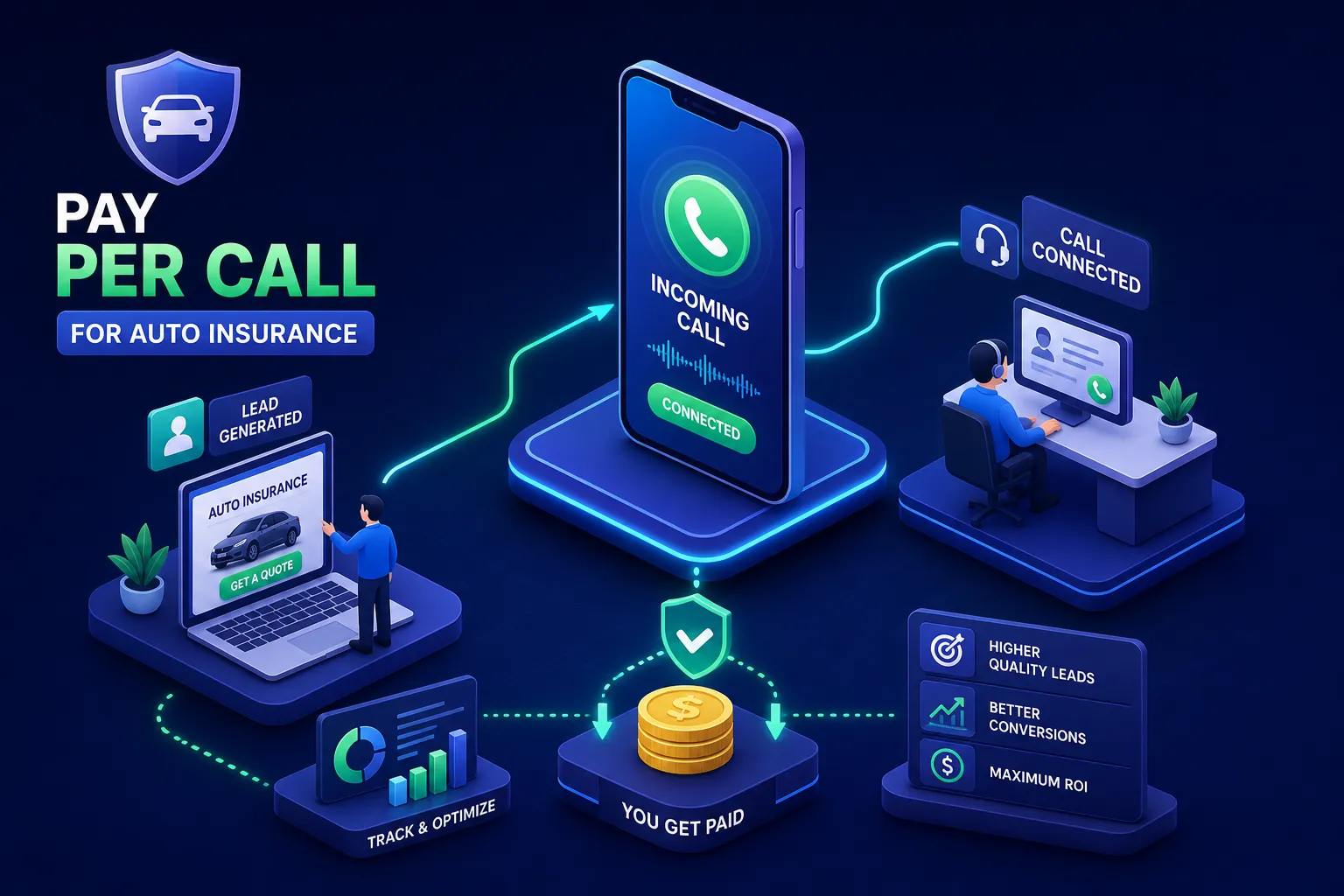
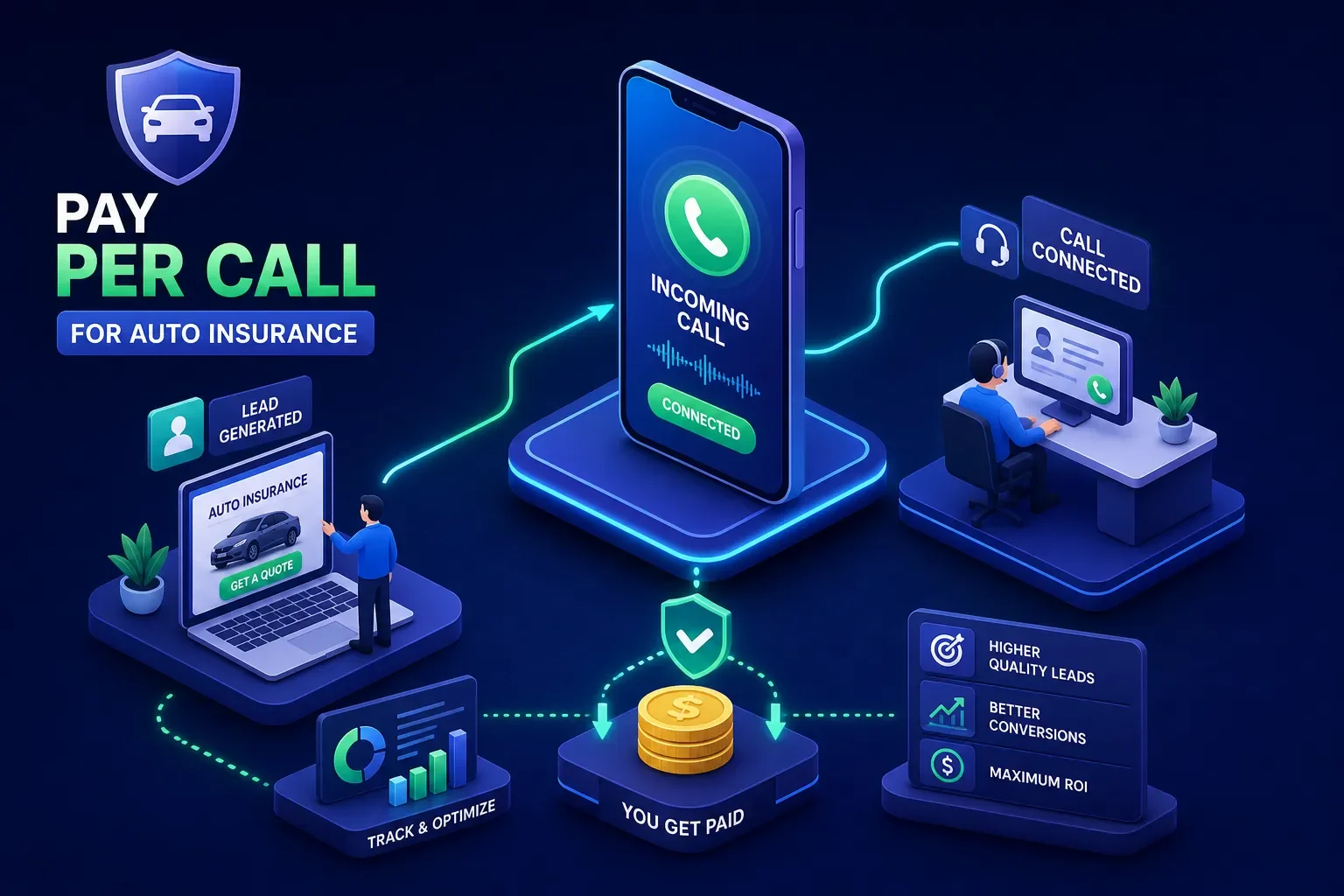
Many auto insurance advertisers still rely on web-form leads that often show lower conversion and higher dropout rates compared with phone leads. Meanwhile, their competitors are picking up the phone to a caller who is already asking for a quote, ready to discuss coverage right now. That gap in buyer intent is real, and it's the structural reason why auto insurance pay per call (also written pay-per-call) has become an increasingly important acquisition channel for top-performing carriers and brokers.
In a pay-per-call model, advertisers pay only when a real, qualified person calls in and meets a defined threshold, not for clicks, impressions, or form fills. The economics are straightforward: you pay for live conversations with prospects who are actively shopping for coverage, and nothing else. Performance networks built specifically for this channel invest heavily in routing technology, IVR qualification, and fraud detection to ensure the calls you buy are the calls you wanted. That infrastructure is a meaningful distinction in a market where traffic quality varies widely.
This guide covers how the model works mechanically, why inbound callers convert so much better than web leads, what calls cost by market, and how to track performance and protect your budget from fraud.
How auto insurance pay-per-call works
Unlike CPM or CPC buying, you are not paying for eyeballs or clicks. You are paying for a live conversation with a prospect who has already decided they want to talk to someone about auto insurance right now. That distinction matters because the cost of an unqualified conversation in insurance is high, and the value of a confirmed buyer is significant enough that the economics only work when billing is tied to actual intent.
The basic pricing model and when you actually pay
Many programs require a minimum connected call duration of 60 to 120 seconds before a call becomes billable, with 90 to 120 seconds being a common threshold among insurance-focused networks. That floor is not arbitrary; it functions as a proxy for qualifying intent. A caller who hangs up in 30 seconds has not engaged with an agent in any meaningful way, so charging for that call would misalign the incentives between the network and the advertiser. For auto insurance, typical cost per connected call ranges from $15 to $45 depending on competition tier, geography, and the qualification requirements built into the campaign.
Where these inbound callers come from
Callers reaching a pay-per-call auto insurance campaign have typically come through paid search ads, social media click-to-call placements, affiliate publisher sites, or insurance comparison portals. The important detail is that they have already self-selected: they searched for insurance terms and then chose to call, which is a higher-intent action than filling out a form. That self-selection is why call quality varies meaningfully by traffic source. Sourcing transparency from your network partner isn't a nice-to-have, it's a core quality signal that separates productive programs from ones that burn budget on marginal traffic.
Live transfers vs. direct inbound calls
Two delivery formats exist in this channel. A direct inbound call routes the caller straight to the advertiser after a brief IVR qualification sequence. A live transfer adds a pre-screening step where an agent at the network level confirms key details, state eligibility, current coverage status, before connecting the call to your team. Both formats work for auto insurance. Live transfers tend to reach the high end of the conversion range because the prospect has already been pre-qualified by a human; direct inbound calls offer higher volume at a lower per-call cost.
How auto insurance pay-per-call routing and verification actually work
A call reaching your agent is not the same as a qualified call reaching the right agent at the right time. Real-time routing, IVR qualification, and fraud detection are what separate a productive pay-per-call program from one that burns budget on low-intent or invalid traffic.
Real-time call routing and how it connects callers to the right agent
When a call comes in, the routing system checks geography, time-of-day scheduling, advertiser capacity, and campaign priority in real time, then connects the caller to the best available buyer. For multi-advertiser networks, routing logic also manages overflow so callers are not sent to unavailable agents or held in queues that kill conversion. The whole process happens in seconds and is invisible to the caller.
Qualification checks that filter out low-intent callers
The most effective IVR and pre-screen filters for auto insurance verify state eligibility, vehicle ownership, and active shopping intent. Asking whether the caller is currently insured and looking to switch or add coverage separates shoppers from browsers in the first 60 seconds of a call. These checks correlate directly with close rates: calls that clear state eligibility and confirm vehicle ownership require fewer back-and-forth steps once an agent is on the line, which shortens the sales cycle and increases bind probability.
What a strong call quality score looks like in practice
A call quality score measures the percentage of connected calls that meet all agreed-upon qualification criteria, pass fraud detection checks, and result in a legitimate agent conversation. Ray Advertising reports a 95%+ call quality score across its auto insurance campaigns, a figure the company attributes to real-time routing technology, IVR pre-screening, and active fraud monitoring across its publisher network. Treat that as a vendor claim to verify, not an industry baseline. When evaluating any network, ask for the methodology behind their quality score, not just the number. A claim without a documented process is a marketing statement, and you should hold any prospective partner to a higher standard than that.
Why inbound callers convert so much higher than web form leads
The conversion gap between phone-based and form-based leads in auto insurance is structural, and it traces back to a simple behavioral difference in how each type of prospect enters the pipeline.
The intent gap between a phone caller and a form filler
Filling out a web form is a passive, low-friction action that requires almost no commitment. A consumer can submit their information, open two other browser tabs for competitors, and walk away from the computer. A caller has already decided they want to talk to someone right now. That behavioral difference translates directly into engagement quality once an agent answers: callers are further along the decision process, more willing to answer underwriting questions, and far less likely to ghost after first contact.
Conversion benchmarks: pay-per-call vs. exclusive leads vs. shared web leads
Qualified inbound call leads in auto insurance convert to a policy sale at approximately 15 to 30%, with live transfers typically reaching the high end of that range. Exclusive web leads fall in the 8 to 15% range. Shared web leads, sold to multiple agents simultaneously, land around 4 to 8%. Pay-per-call leads convert roughly 2x to 4x better than shared web leads, and the gap versus exclusive web leads is still substantial.
Translating this into cost-per-acquisition math clarifies the real value. If you pay $35 per connected call and close 20% of those calls, your cost per acquisition is $175. If you pay $12 for a shared web lead and close 5%, your cost per acquisition is $240, and you have spent the same budget on a worse outcome. The per-unit price of a call looks higher in isolation; the CPA math often tells a different story.
Pay-per-call pricing for auto insurance markets
Understanding per-call costs in the abstract is not enough. You need to calibrate expectations against the specific states and competition tiers you operate in before you set campaign budgets.
Typical per-call price ranges by competition tier
Low-competition states, including Ohio, Maine, Iowa, and Vermont, typically price around $15 to $25 per connected call. Moderate-competition markets sit around $25 to $35. High-competition states like Florida, Michigan, Nevada, New York, and Louisiana often run $35 to $45 or higher. The variation is driven by underlying premium levels, carrier density in the state, consumer shopping frequency, and the volume of competing advertisers bidding for the same calls.
How to calculate whether a call is worth the price you're paying
Take your average first-year revenue per policy, multiply by your close rate on qualified calls, and compare the result to your cost per call. If a call costs $40 and closes at 20%, your cost per acquisition is $200. If that policy generates $700 in first-year premium at a 60% margin, you are netting $220 per acquisition after the call cost. Networks that offer lower per-call costs but poor qualification will almost always produce higher CPAs. Evaluate cost per call as part of your full acquisition economics, not as an isolated line item.
How to track performance and protect your budget from fraud
Even the best pay-per-call program will underperform without the right measurement infrastructure. Attribution, fraud detection, and compliance shape whether you can optimize the program or are flying blind.
Call attribution and tracking setup before you launch
Set up unique tracking numbers for each campaign and traffic source before you spend a dollar. That means connecting those numbers into your CRM and ad platforms, Google Ads, Salesforce, HubSpot, so you can follow calls through to closed policies rather than stopping at first contact. For attribution tooling, Invoca is a widely recommended option for insurance-specific ROI tracking because it ties calls directly to quotes and policies written. Ringba is built for high-volume pay-per-call buying and routing. Phonexa covers the full stack: call tracking, fraud prevention, compliance, and billing in one platform. Attribution must be configured before spend begins, not retrofitted after you notice gaps in the data.
Fraud detection and TCPA compliance practices to build in from day one
The main fraud risks in call-based lead generation are bot-generated calls, recycled lead calls, and misrepresented caller intent. Good networks use real-time filtering to block invalid traffic before it reaches the billing threshold. Ask any prospective partner exactly how they handle duplicate call filtering and invalid traffic detection before you sign a contract. On the compliance side, TCPA exposure in auto insurance is real. Any program that involves dialing or transferring consumers needs documented consent capture and call recording as an audit trail. These aren't bureaucratic requirements, they are the difference between a defensible program and a liability.
How to choose the right pay-per-call partner for auto insurance
Not all call networks operate at the same standard. The difference between a productive program and a wasted budget often comes down to the quality of the partner running the calls, not the channel itself.
Non-negotiable criteria when vetting any call network
Before committing budget, demand the following from any prospective partner:
- A published call quality score with a documented methodology, not just a marketing claim
- Real-time call routing with geo-targeting and time-of-day scheduling controls
- IVR qualification that maps to your specific underwriting criteria
- Built-in fraud detection with duplicate call filtering
- Transparent reporting with call recordings and outcome data
- Rapid campaign onboarding with a dedicated account manager
Why Ray Advertising is structured for this channel
Ray Advertising runs auto insurance call campaigns on a fully performance-based model: advertisers pay only for calls that meet qualification criteria, not for traffic or impressions. The company reports a 95%+ call quality score, backed by real-time routing, IVR pre-screening, and active fraud monitoring across its publisher network. Campaigns are designed to go live quickly with custom geo-targeting, time-of-day scheduling, and a dedicated account manager handling ongoing optimization.
For auto insurance advertisers who need quality, compliance, and scale together, that combination is difficult to find in this channel. Ray Advertising's in-house media buying capabilities also provide a more stable call supply during competitive enrollment periods when third-party publisher inventory gets thin, giving you additional leverage when volume matters most.
The bottom line on auto insurance inbound call campaigns
The auto insurance pay-per-call model works because cost is tied directly to buyer intent: you pay when a qualified person calls, not when someone clicks or submits a form. Inbound callers convert at 2x to 4x the rate of shared web leads because the act of calling filters out passive browsers before an agent ever picks up. And the difference between a productive program and a wasted budget comes down to how well calls are routed, screened, and attributed before they reach your team.
If you are ready to add high-intent auto insurance leads to your acquisition mix, the next step is finding a network that can document its quality standards and put them in writing. Ray Advertising can walk you through its quality methodology and help you structure a campaign before you commit budget, start there.
Recent Post

How to Scale Lead Generation Without Losing Qualit...
August 17, 2026
Improve Lead Generation Quality Without Losing Vol...
August 16, 2026
Reduce Cost Per Acquisition: 12 Tactics That Work...
August 14, 2026
Reduce Cost Per Acquisition: 12 Tactics That Work...
August 13, 2026
Car Insurance Leads for Agents: Best Sources and S...
August 12, 2026
What Are SR22 Insurance Leads and Why Are They So ...
August 11, 2026
Auto Insurance Pay Per Call: How It Works and Why ...
August 10, 2026
How to Buy Auto Insurance Leads That Actually Conv...
August 9, 2026
High Risk Auto Insurance Leads: How to Target and ...
August 8, 2026
Related resources
Explore the most relevant pages based on this article.
- Contact Ray Advertising — Ask about pricing, compliance, and launch timelines.
- Pay Per Call — Call validation, tracking, routing, and TCPA-aware operations.
- Advertiser Solutions — Launch pay per call campaigns with full visibility and controls.
- Publisher Program — Promote compliant pay per call offers with competitive payouts.
- Media Buying — Add intent-driven traffic sources to scale volume.

FAQs
Quick answers related to this article.
A qualified call connects to the destination and meets the campaign’s duration, geo, and quality rules.
Yes. You can use allowlists, blocklists, caps, and source-level rules to control traffic.
Yes. Tracking numbers, attribution, and call-level reporting are available based on your configuration.

