


Auto Insurance Live Transfer Leads: How They Work and Why Agents Love Them
By Ray Advertising · Published August 6, 2026
Auto Insurance Live Transfer Leads: How They Work and Why Agents Love Them
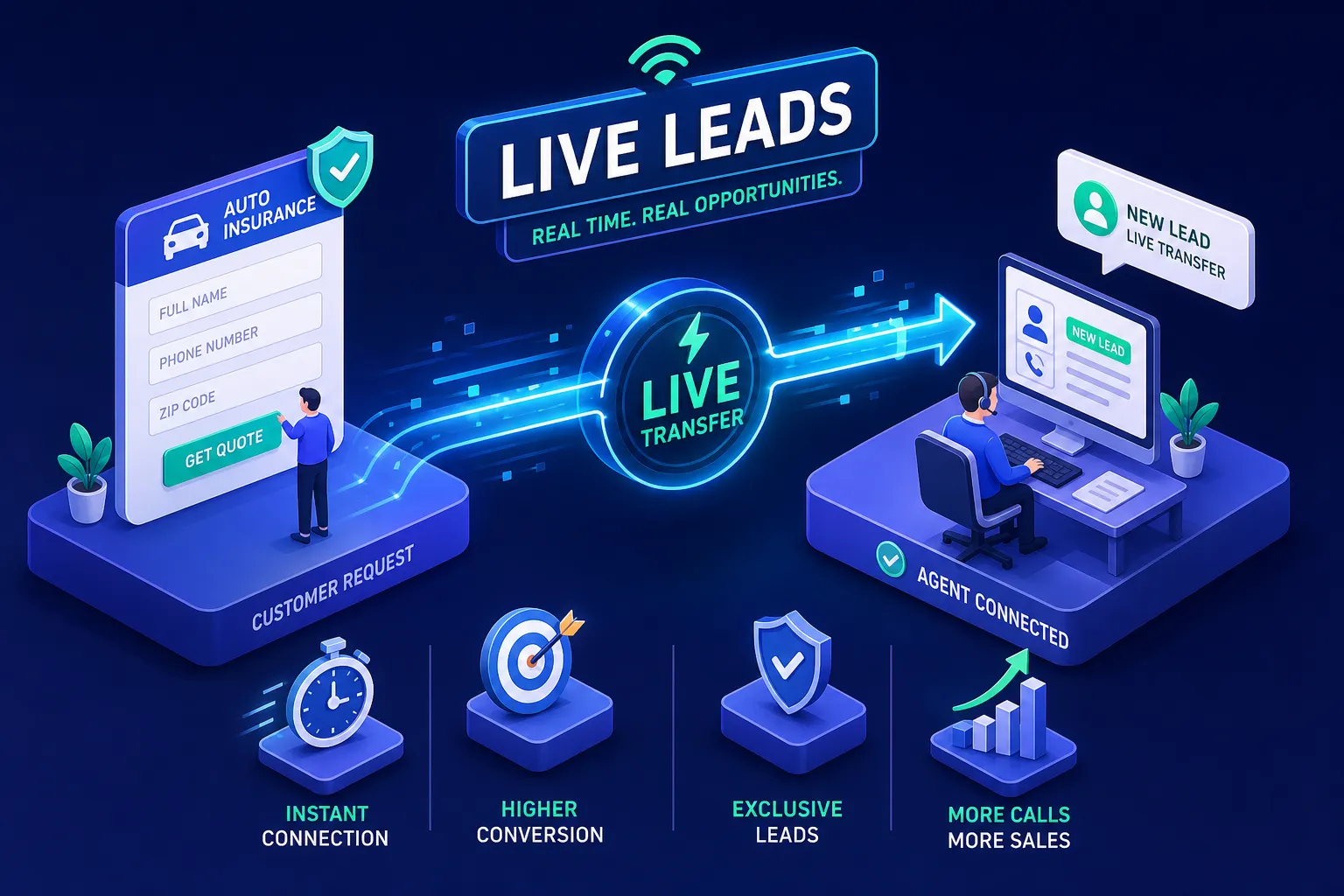
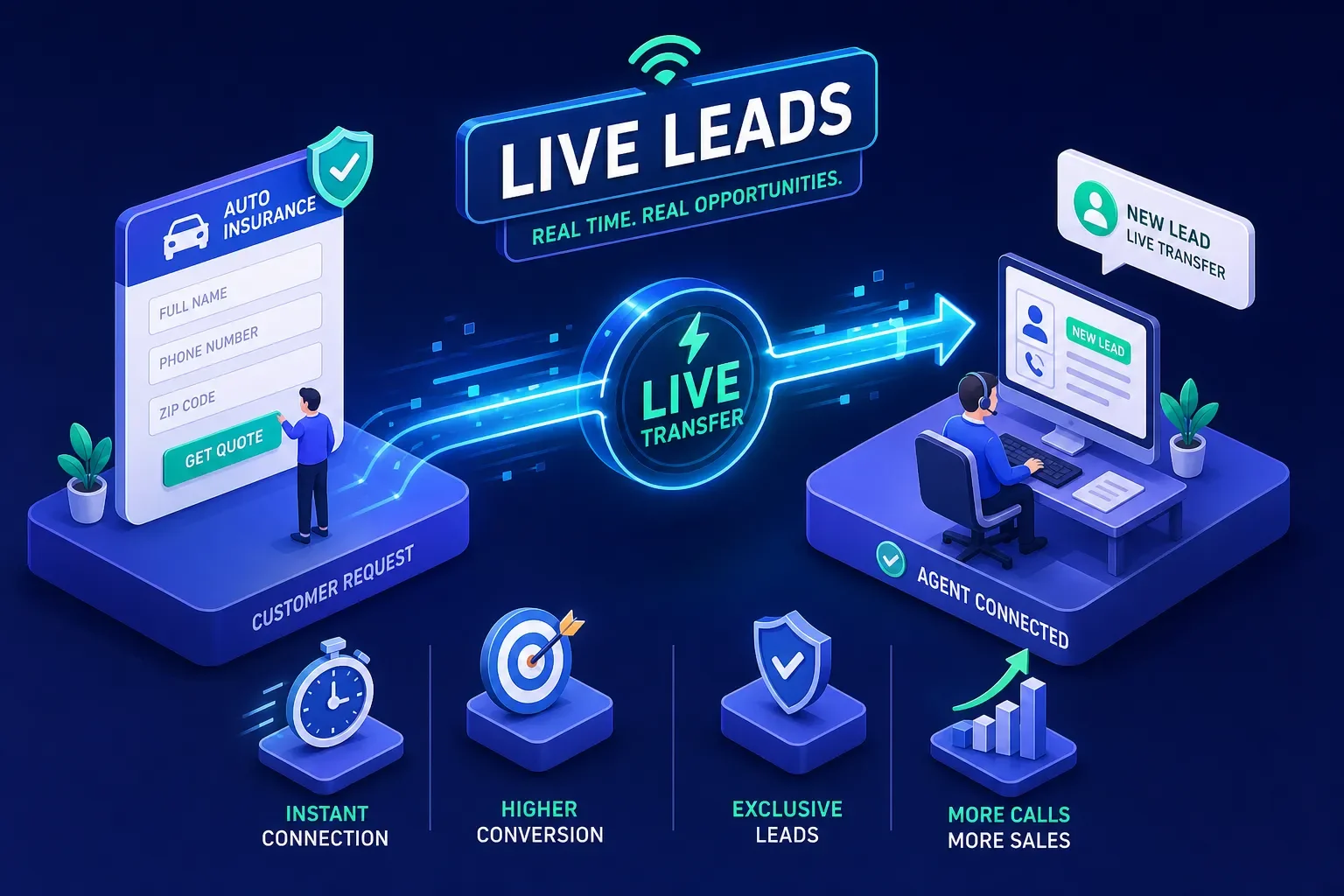
Every insurance agent knows the feeling. You buy a batch of form-fill leads, block off two hours for outreach, and walk away with three conversations and a pile of disconnected numbers. The rest are cold, annoyed, or simply gone. Auto insurance live transfer leads solve that problem at the source: instead of chasing a name on a list, you pick up the phone and a pre-qualified buyer is already there, ready to talk.
This is not a marginal improvement over standard web leads. It is a structural shift in how the agent-to-consumer conversation begins. Based on Ray Advertising campaign data, the performance gap between live transfers and form-fill leads is consistent and measurable across insurance verticals. Contact rates, close rates, and cost per acquisition all move in the same direction when agents switch from form-fill to live transfer programs.
This guide covers exactly what live transfer leads are, how the process works from first consumer click to your live conversation, what the right pricing looks like, and what you need on your end to close at a rate that makes the math work.
What auto insurance live transfer leads actually are
A live transfer lead is a phone call where a pre-screened consumer, who has confirmed they want to speak with an auto insurance agent, is transferred directly to a licensed producer in real time. This is not a callback request, a form submission, or a scheduled appointment. The consumer is on the line when you pick up.
The mechanics are meaningfully different from web leads. A form-fill captures a name and contact information; the agent then spends time chasing the consumer down. With a live transfer, the consumer initiated contact, went through an intake screening, and agreed to speak with an agent. The contact problem is already solved before the call reaches your queue.
Why pre-qualification changes the entire conversation
Intake screening typically covers the consumer's current carrier, vehicle details, state of residence, and active interest in switching or shopping for a new rate. By the time the call transfers to you, the consumer has confirmed intent and is expecting to talk. You open a conversation, not a cold pitch. That distinction matters more than most agents initially realize, because it changes your tone, your pacing, and your close rate from the first sentence.
How the transfer process works from first contact to your phone
The transfer journey has three distinct stages: consumer acquisition, intake screening, and the warm handoff. Understanding each stage helps you evaluate vendor quality and identify where breakdowns happen when a campaign underperforms.
The consumer acquisition and intake screening stage
A consumer clicks an ad, fills a short form, or calls an intake number. An intake agent or automated screening system asks qualifying questions to confirm the consumer is a real, interested buyer. Depending on the vendor and qualification depth, screening often takes a few minutes and covers the basic qualifying criteria your campaign requires. Vendors that run rigorous screening at this stage consistently produce higher-quality transfers. Those that rush or skip it deliver volume without value.
The warm handoff and real-time routing
Once the consumer clears intake, the intake agent confirms they are ready to speak with a licensed agent and initiates the transfer. In well-built systems, this handoff happens in under 30 seconds. The consumer stays on the line, you pick up, and the intake agent briefly introduces both parties before dropping off. That introduction is the detail that separates a true warm transfer from a simple call forward. The warm handoff is what makes the consumer feel like the conversation was expected, not random. Real-time auto insurance lead routing matches the caller's data to your campaign criteria, including state licensing, product line, and availability, before the connection is made.
Why live transfers consistently outperform form-fill leads
The performance case for live transfer calls is not just qualitative. Contact rates and conversion data make the ROI argument clearly, and the numbers are not close. Live transfers deliver near-universal connectivity and close rates that web leads rarely approach, even across well-managed campaigns.
Contact rates and what near-100% connectivity means for your day
Standard web leads have contact rates that routinely fall below 30% after multiple call attempts, a figure consistent with industry-reported benchmarks for form-fill outreach. Live transfers carry contact rates near 95 to 100% because the consumer is already on the phone when your line rings. An agent staffed correctly will connect with essentially every transfer they receive. The math on productivity alone justifies the higher per-transfer cost before you even factor in conversion rate.
Conversion benchmarks every agent should use
Strong live-transfer programs in auto insurance produce close rates of 20 to 30% per connected call. That means for every 10 transfers received, two to three become issued policies. Compare that to web leads, where a 5 to 10% close rate from initial form submission to bound policy is often considered solid performance. If your average auto policy generates $500 in first-year commission, a reasonable illustrative figure depending on market and carrier, the margin difference between those two models is significant at any reasonable transfer price. Know your average policy value before you negotiate transfer pricing, because the right price depends entirely on what the math produces at your close rate.
Pricing for auto insurance live transfer leads
Agents evaluating live-transfer vendors need to understand what market pricing looks like and how to calculate whether the spend makes sense before committing to a campaign. The per-transfer model is standard; subscriptions are rare but do exist.
What the market charges per transfer in 2026
The standard range for pay-per-call insurance leads in the auto vertical sits between $25 and $55 for market-rate calls. Exclusive, tightly filtered, or higher-intent transfers push that range to $60 to $100 and occasionally higher depending on vertical, state, and qualification depth. Most vendors sell on a per-transfer basis rather than a flat subscription. Some require minimum monthly spend commitments, particularly at lower price points, so build that into your budget planning from the start.
A simple ROI formula for auto insurance agents
The formula is straightforward: cost per transfer divided by your close rate equals your cost per acquisition. If a transfer costs $40 and you close at 25%, your effective cost per bound policy is $160. If the average auto policy pays $500 in first-year commission, the margin is clear. Run this calculation at your actual close rate before signing with any vendor, because what looks expensive per transfer can look very different when you factor in what each policy is actually worth to your book.
Staffing for auto insurance live transfer leads
Live transfers are perishable. A consumer who waits on hold for 90 seconds while an agent scrambles to get ready is already mentally checked out. The operational setup on your side determines whether the vendor's pre-qualified call becomes a closed policy or a wasted transfer fee.
How fast you need to answer and how to structure your routing
In our campaigns, live transfers go cold in as few as 8 seconds of hold time. Agents should treat every live transfer like a call that absolutely cannot go to voicemail. Smart call routing that connects the transfer to the first available licensed producer immediately is non-negotiable. If your agency runs multiple producers, define a clear queue so every transfer has an owner the moment it arrives. The 80/20 service level standard, 80% of calls answered within 20 seconds, is the minimum target. Staff to hit it during peak call windows, not just on average.
The opening script structure that closes more calls
A confirmatory opener outperforms a traditional sales greeting on every metric. Lead with the consumer's name, confirm the reason for the call in one sentence, and ask one focused question:
"I understand you were looking for a new auto quote. What matters most right now, lower price, better coverage, or both?"
That question does two things: it confirms intent and immediately surfaces the consumer's buying driver. From there, ask one consultative question about their current carrier, present a single clear recommendation, and move directly to the next step. Avoid re-asking information the intake agent already collected. If the consumer has to repeat themselves, your conversion rate drops and so does their patience.
What separates a reliable live-transfer vendor from a risky one
Not all live-transfer vendors deliver the same product. Intake screening depth, call routing infrastructure, and quality assurance standards vary significantly across providers. An agent buying at $30 per transfer from a vendor with weak screening is not getting a better deal than one paying $50 from a vendor with verified intent and rigorous call quality controls.
The backend infrastructure that determines call quality
The real differentiator is the technology behind the transfer. Vendors running real-time call routing with active quality scoring can identify and filter low-intent calls before they reach an agent. Vendors commonly target a 95%+ threshold on internal quality metrics, meaning the vast majority of transfers delivered represent consumers who genuinely want to speak with an agent. That benchmark should be a baseline question in every vendor evaluation conversation. At Ray Advertising, pay-per-call campaigns are built on real-time routing and fraud detection integrated directly into the platform, not bolted on as an afterthought, with quality controls designed to meet that standard consistently.
Red flags that signal a vendor isn't worth your budget
Watch for vendors who cannot explain their intake screening process or refuse to share call recordings for quality review. Vendors who don't offer credit policies for disconnected or invalid transfers are also worth scrutinizing. Compliance is the clearest dividing line: reputable vendors collect seller-specific TCPA consent before every transfer, maintain call recording disclosures, and can produce documentation to prove it. In 2026, that means prior express written consent that names your specific agency, not a generic "partner" disclosure. If a vendor sidesteps compliance questions during your evaluation, the legal and financial risk shifts entirely to you the moment that call connects.
The bottom line on auto insurance live transfer leads
Auto insurance live transfer leads remove the two biggest friction points in insurance sales: getting the consumer on the phone and confirming they actually want to buy. When the intake process is rigorous, the routing infrastructure is fast, and you are staffed and scripted to close from the first word, live transfers produce results that form-fill leads simply cannot match.
The variables you control are the vendor you choose, the staffing model you build around the campaign, and the script you use to close. Start by knowing your close rate and average policy value, then work backward to find the transfer price that makes the math work. As a next step, consider running a defined trial volume, 50 to 100 transfers is a reasonable baseline, so you have enough data to evaluate vendor quality before scaling spend. Evaluate vendors on screening depth, call quality scoring, routing reliability, and compliance standards.
Get those inputs right, and live transfer calls become one of the most predictable lead channels an insurance agency can run. If you want to see what a properly built live-transfer program looks like in practice, Ray Advertising runs auto insurance call campaigns with real-time routing and dedicated account management. Onboarding timelines vary depending on inventory and licensing requirements, but campaigns are designed to get to market quickly. The math works when the setup is right.
Recent Post

How to Scale Lead Generation Without Losing Qualit...
August 17, 2026
Improve Lead Generation Quality Without Losing Vol...
August 16, 2026
Reduce Cost Per Acquisition: 12 Tactics That Work...
August 14, 2026
Reduce Cost Per Acquisition: 12 Tactics That Work...
August 13, 2026
Car Insurance Leads for Agents: Best Sources and S...
August 12, 2026
What Are SR22 Insurance Leads and Why Are They So ...
August 11, 2026
Auto Insurance Pay Per Call: How It Works and Why ...
August 10, 2026
How to Buy Auto Insurance Leads That Actually Conv...
August 9, 2026
High Risk Auto Insurance Leads: How to Target and ...
August 8, 2026
Related resources
Explore the most relevant pages based on this article.
- Contact Ray Advertising — Ask about pricing, compliance, and launch timelines.
- Lead Generation — High-intent leads with delivery and quality controls.
- Pay Per Call — Qualified inbound calls with tracking and routing.
- Media Buying — Performance media with optimization and attribution.
- Affiliate Network — Vetted publishers and fraud protection.

FAQs
Quick answers related to this article.
We support lead generation, pay per call marketing, media buying, and affiliate network programs.
We use source attribution, quality metrics, and conversion reporting to optimize and scale profitable traffic.
Contact our team or sign up as an advertiser or publisher to begin onboarding.

