


Why API Lead Delivery Outperforms CSV Faster, Cleaner, and Built for Scale
By Ray Advertising · Published May 4, 2026
Most companies focus on getting more leads. But few stop to ask a simple question. How do those leads actually reach their system?
The delivery method plays a bigger role than most people realize.
The way leads move from a lead provider to a buyer can affect response time, data accuracy, and how easily sales teams work inside their CRM.
Two delivery methods are common in lead generation. One relies on files that must be handled and uploaded. The other connects systems, so data moves automatically.
At first glance, the difference may seem technical. In practice, it can change how efficiently a lead program runs.
To see why API delivery is the smarter choice, let’s look at how both approaches work and where the real advantages appear.
The Problem With Traditional CSV Lead Delivery
Many lead vendors still send leads through CSV files.
The process is simple but slow. A file is created. It is then sent by email or shared through a download link. After that, someone has to upload the file into a CRM.
During this time, the leads are just sitting in a file. They are not yet inside the buyer’s system.
This workflow also depends on manual work. Someone has to download the file. Someone has to import it. If the file format is incorrect, the upload may fail, and the process restarts.
CSV files can also create data problems. Columns may not match the CRM fields. Some data may appear in the wrong place. These errors take time to fix.
While all this is happening, the sales team is still waiting.
In lead generation, speed matters. The longer a lead waits, the less valuable it becomes.
What API Lead Delivery Actually Means
Many people are not sure what an API is.
An API is a direct connection that sends lead data from one system to another in real time.
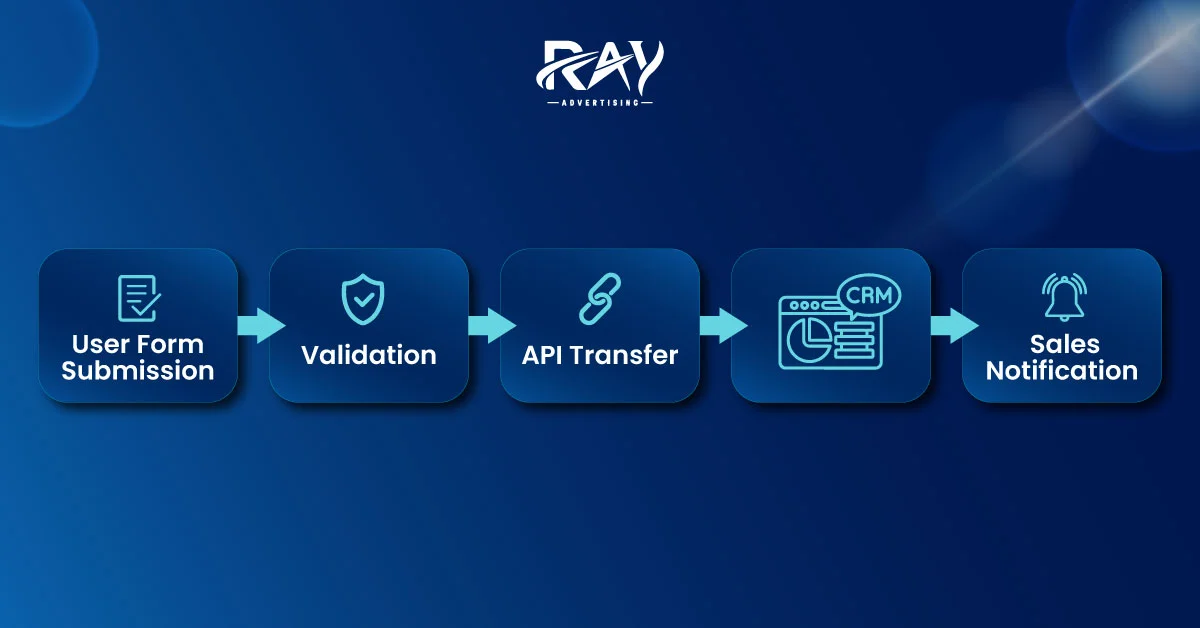
This is how it works in a typical lead flow:
- A user submits a form.
- The lead passes validation.
- The system sends the lead directly to the buyer’s CRM.
- The sales team receives it immediately.
CSV vs API delivery at a Glance:
|
Feature |
CSV Delivery |
API Delivery |
|
Lead delivery |
Sent in files |
Sent instantly |
|
Speed |
Delayed |
Real time |
|
Data errors |
Common during imports |
Structured and validated |
|
Automation |
Manual uploads |
Fully automated |
|
Scaling |
Batch based |
Continuous flow |
With API delivery, leads reach your sales team faster. The data is cleaner. The process runs automatically and can handle large volumes without slowing down.
Speed: Leads Reach Sales Teams in Seconds
Speed is the main reason companies switch to API delivery. When leads arrive fast, your sales teams can reach out while interest is high.
Speed matters for three big reasons:
- Higher contact rates: You are much more likely to get someone on the phone if you call them right after they submit a form.
- Better conversion: People are more ready to buy when their problem is fresh in their minds.
- Less competition: If you call first, you beat other companies to the deal.
Studies show that response time is the biggest factor in closing a sale. Many companies lose their deals simply because they take too long to reach out.
CSV delivery causes a delay. API delivery removes that delay and gets leads to sales teams instantly.
Data Accuracy Improves With Direct System Delivery
CSV files often create data problems. Columns can break, fields may not match the CRM, and formats can change, which can mix up the data. Even small mistakes can slow down your sales team.
API delivery avoids these issues. Data is sent in a structured format, ready for your CRM. We map each field correctly. The system validates every lead automatically before it reaches you.
The benefits are clear:
- Fields map automatically.
- No manual formatting or fixes are needed.
- Fewer import errors save time.
- CRM records stay reliable.
Clean data helps sales teams focus on connecting with real leads. Over time, this improves conversion rates and overall campaign performance.
Real-Time Validation Protects Lead Quality
With most CSV systems, you only find out a lead is bad after you have paid for it and uploaded it. By then, the wrong phone number or fake email is already in your CRM.
API delivery works differently. It allows for real-time validation. The system checks the lead the moment it is submitted, before it reaches you.
Common real-time checks include:
- Required fields
- Phone number formatting
- Duplicate detection
- Location validation
- Fraud signals
Filtering leads before delivery keeps your CRM clean. It also protects campaign performance and helps sales teams focus on real, high-quality leads.
Compliance is Easier to Control
Compliance is a growing concern in lead generation. Companies must follow rules around consent, data storage, and lead sharing. Breaking these rules can lead to fines, lost trust, and wasted campaigns.
CSV delivery makes compliance harder. Files can be copied, stored on personal devices, or shared accidentally. Once a file leaves the vendor, it is hard to track who has it or where it goes.
API delivery works differently. Leads move directly from the vendor to your system. The process stays inside controlled systems, so data is safer and easier to manage.
Key advantages include:
- Consent data travels with the lead.
- Timestamp and source tracking for every lead.
- Clear audit trail of all actions.
- Easier compliance checks.
API delivery lets buyers track the source of every lead in real time. It reduces risk, builds trust, and ensures campaigns stay compliant.
Automation Reduces Operational Work
CSV workflows rely on manual steps. In many offices, someone has to spend part of their day just moving data around. They have to export the file, send it, and then someone else has to upload it. If there are any errors, someone has to go in and fix them by hand.
API delivery automates the entire process. Leads move directly from the source to your CRM without human intervention.
Automation removes tasks like:
- File exports
- Email transfers
- Manual uploads
- Formatting fixes
When you remove these manual steps, you also remove the chance for human error. Less manual work means fewer mistakes and a much smoother day for your team.
API Delivery Makes Scaling Much Easier
CSV systems often struggle when lead volume grows. Large files can slow down systems. Manual imports take longer, and errors become more common. This can create delays and frustration for sales teams.
API delivery handles large volumes much better. Leads move continuously through the system instead of waiting in batches. The process stays fast and reliable, no matter how many leads come in.
This makes it easier to grow campaigns without extra work. Sales teams get leads quickly. Data stays accurate, and operations run smoothly, even at high volume.
How Our System Uses API Delivery to Protect Buyers
At Ray Advertising, we use API delivery to do more than just send data. We use it to protect your business. Our system acts as a smart filter, making sure only the best leads reach your team.
Here’s how our API works in practice:
✔ Real-time lead validation
We check every lead the moment it’s created. If a phone number is fake or a field is empty, the lead is stopped before it reaches you.
✔ Automated routing
Once a lead passes our checks, it is sent directly to your system. There are no files to wait for and no manual steps.
✔ Fraud detection
We use built-in tools to spot bot traffic and fake entries. We block these threats instantly to keep your CRM clean.
✔ Instant integration
Our system connects directly with your CRM. This means your data is always structured and ready for your sales team to use.
We don’t just send leads faster. We deliver verified, organized data that’s easy to track. This ensures your team spends time talking to real people who are ready to hear from you. That difference is what helps our buyers grow their business with confidence.
When CSV Delivery Still Makes Sense
Even though API delivery is faster and more reliable, CSV files still have a place. For some smaller or specialized tasks, they can be practical and convenient.
CSV delivery can still be useful in certain cases:
- Small campaigns with low lead volume.
- Manual reporting or internal reviews.
- Backup exports for offline analysis.
However, CSV should not be the main method for active lead flow. It is slower, often causes errors, and can delay your sales team.
Why API Delivery Wins for Buyers
In lead generation, speed and control matter most. To grow, you need a system that works as fast as your customers do.
Switching to API delivery improves your business in four main ways:
- Speed: Leads reach your team in seconds, not hours.
- Data Accuracy: No more broken columns or messy information.
- Compliance: Clear audit trail and proof of consent for every lead.
- Quality Control: Bad data and fraud are blocked before they reach you.
CSV delivery is too slow and fragile for modern business. It creates delays and leaves room for errors. API delivery is built for how lead generation works today.
For buyers, the choice is clear. Moving away from manual files means faster contact with customers, cleaner data in your CRM, and better campaign results
Recent Post
How to Scale Lead Generation Without Losing Qualit...
August 17, 2026
Improve Lead Generation Quality Without Losing Vol...
August 16, 2026

Reduce Cost Per Acquisition: 12 Tactics That Work...
August 14, 2026
Reduce Cost Per Acquisition: 12 Tactics That Work...
August 13, 2026
Car Insurance Leads for Agents: Best Sources and S...
August 12, 2026
What Are SR22 Insurance Leads and Why Are They So ...
August 11, 2026
Auto Insurance Pay Per Call: How It Works and Why ...
August 10, 2026
How to Buy Auto Insurance Leads That Actually Conv...
August 9, 2026
High Risk Auto Insurance Leads: How to Target and ...
August 8, 2026
Related resources
Explore the most relevant pages based on this article.
- Contact Ray Advertising — Ask about pricing, compliance, and launch timelines.
- Lead Generation — Lead scoring, duplicate removal, compliance screening, and delivery.
- Advertiser Solutions — Brand-safe performance marketing for measurable ROI.
- Pay Per Call — Qualified inbound calls with validation and tracking.
- Media Buying — Intent-driven traffic with tracking and controls.

FAQs
Quick answers related to this article.
A qualified lead meets your targeting rules (geo, intent, required fields) and passes duplicate and compliance filters.
We run suppression and matching checks in real time and can enforce recency windows and field-level matching rules.
Campaigns use approved creatives, consent-aware flows, and monitoring to flag and pause non-compliant sources.

